Epoxy Flooring and Moisture in the Willamette Valley
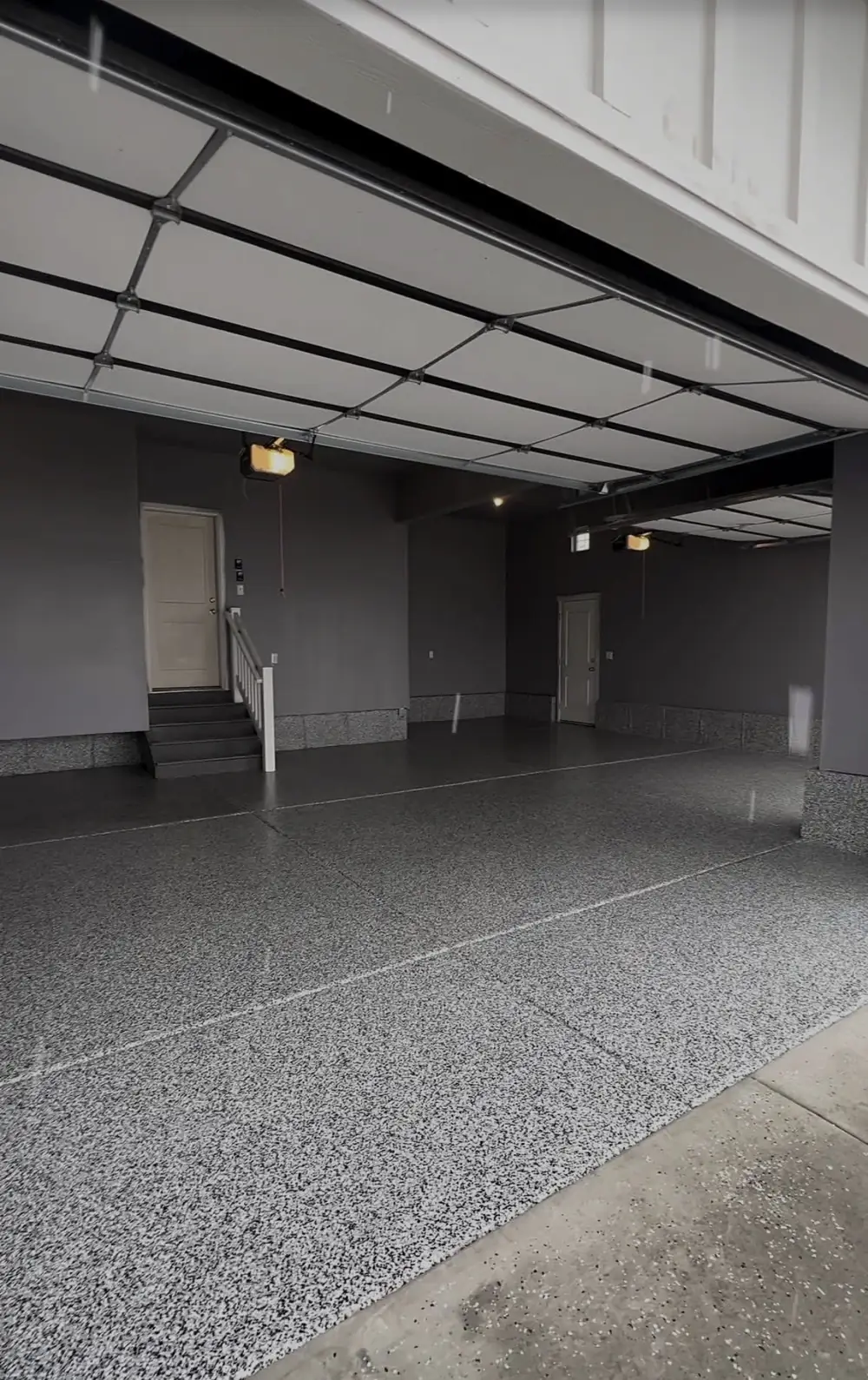
Quick answer: Epoxy floors work well in Oregon's wet climate when moisture is managed. The slab must be diamond-ground, checked for moisture vapor, and primed with a moisture-tolerant product if readings are high. Installs also need slab temperatures above product minimums and above the dew point, which matters in cool, damp Keizer winters.
Most epoxy failures we see around Keizer and Salem aren’t caused by bad resin. They’re caused by water: vapor rising through the slab, a coating applied to damp or cold concrete, or oil and contamination nobody removed. This guide explains what’s different about coating concrete in the Willamette Valley and what a good contractor should do about it.
How does Oregon rain affect garage floors?
Salem and Keizer average roughly 40 inches of precipitation a year, concentrated from October to May, with long stretches of gray, drizzly weather and high humidity. That means cars bring water into the garage almost daily, garage air stays damp, and the ground under the slab stays wet for months. Uncoated concrete absorbs that water, stains, grows dust, and can show white efflorescence as moisture carries salts to the surface.
What is moisture vapor transmission, and why does it matter?
Concrete is porous. When the soil below is wet and the air above is drier, water vapor moves up through the slab — this is the moisture vapor emission rate (MVER). Many older Mid-Valley homes were built without a plastic vapor barrier under the slab. If a coating that isn’t designed for vapor goes down, pressure builds under the film and causes blisters, bubbles, or delamination months later.
- Warning signs: dark damp patches, white powdery efflorescence, a plastic mat that “sweats” underneath overnight, musty smell in basements
- Testing: a simple plastic-sheet test gives a first read; calcium chloride (ASTM F1869) or in-slab relative humidity probes (ASTM F2170) give numbers
- Limits: every coating has a manufacturer moisture limit; standard epoxies are lower, moisture-mitigating epoxy primers are rated much higher
How do you install epoxy on a damp Oregon slab?
If moisture is moderate, we use a moisture-mitigating (vapor-tolerant) epoxy primer after grinding. It penetrates and forms a barrier layer that the rest of the system sits on. If there’s liquid water (not just vapor) — hydrostatic pressure, drainage running toward the slab, or a cracked foundation letting water in — no coating is a fix. That needs gutters, grading, or drainage work first, and we’ll say so.
Why does concrete prep matter more in a wet climate?
Diamond grinding removes the weak surface layer (laitance), old sealers, and curing compounds, and opens the pores so primer can soak in and bond mechanically. Acid etching — the DIY shortcut — adds more water to the slab and leaves residue, which is the opposite of what a damp Oregon floor needs. We also degrease oil spots, since oil wicks back up and breaks the bond. Details: our install process.
Can you install epoxy in winter in Keizer?
Often, yes — it’s an indoor job. The rules are about temperature and dew point, not the calendar:
- Slab temperature: many epoxies need the slab around the 50s °F or warmer to cure properly; some polyaspartic products are rated for cooler conditions
- Dew point: the slab should stay at least 5°F above the dew point or condensation forms on the surface and ruins adhesion and gloss
- Heat and airflow: we may use temporary heat and keep the door closed during cure
Cold slows cure, so drive-on times get longer from November to February. That’s one reason many Keizer homeowners choose a polyaspartic topcoat for winter installs.
What about freezing weather and ice storms?
The Willamette Valley doesn’t see Montana-style winters, but it does get frosty nights, occasional snow, and ice storms. For interior garage slabs, freeze-thaw is rarely the problem; the bigger issues are cold slabs slowing cure and de-icer and grit tracked in from icy roads or mountain trips. A chemical-resistant topcoat and a textured flake finish handle both. Exterior concrete (patios, walkways) sees real freeze-thaw and is a different product decision.
How do I keep a coated floor in good shape through rainy season?
- Keep a floor squeegee handy and push standing water out after wet drives
- Use entry mats to catch grit; sweep weekly October–May
- Keep door bottom seals in good shape so wind-driven rain doesn’t pond at the threshold
- Clean with pH-neutral cleaner; skip harsh acids
- Choose flake or add anti-slip to the topcoat for traction when wet
Where we see this most
Moisture matters most on slabs near the Coast Range, in the foothills, on hillsides, and near the river, which is why it comes up on almost every job in Dallas, Silverton, West Salem, and Independence. We also work in Salem, Woodburn, and the rest of the Mid-Valley.
Frequently asked questions
Can epoxy be installed on a damp concrete floor?
Not on visibly wet concrete. Slabs with moisture vapor can be coated after grinding with a moisture-mitigating epoxy primer rated for the measured conditions. Active water intrusion must be fixed with drainage first.
How do I know if my garage slab has a moisture problem?
Look for dark damp areas, white efflorescence, or tape a plastic sheet to the floor for 24 hours and check for condensation underneath. For a definitive number, a contractor can run a calcium chloride or in-slab relative humidity test.
What is the minimum temperature for installing epoxy?
It depends on the product. Many epoxies need slab temperatures in roughly the 50s F or warmer and the slab must stay at least 5 degrees F above the dew point. Some polyaspartic coatings are rated for cooler application.
Does rain on install day matter for an indoor garage?
Rain itself isn't a problem for an interior garage, but high humidity and a cold slab can create condensation. We monitor slab temperature and dew point and adjust heat, airflow, and scheduling.
Who is Keizer Epoxy?
Keizer Epoxy is a locally focused epoxy flooring contractor based in Keizer, Oregon, serving homeowners and businesses across Salem and the Mid-Willamette Valley. We are a service-area business: the fastest way to reach us is (503) 308-7757 (call or text). Learn more on our about page, or see how we work on the install process and prep & warranty pages.
Ready for a written, site-specific quote? Call Keizer Epoxy at (503) 308-7757 or use the form — estimates are free and on-site.
Call (503) 308-7757